



Experiments with liquid antennas
- Grupos de investigación
- Engineering
- Communications Group
- Ana García Armada
- Experiments with liquid antennas
In this video: Continuous Electrowetting experiment with eGaIn, we can see the outcome of a typical experiment to validate the application of Continuous Electrowetting to displace eGaIn drops. That is, by applying a DC current to the edges of the capillary, the changes induced to the properties of the surface of the drop produce a displacement as an outcome. Since our experiments focused on the transitory regime, the input excitation is slowly varying over time, as can be seen in the video.
The diameter of the tube is about 3 mm. The bubbles that are present are not inside the tube, but between the tube and the crystal plates that hold the tube to be straight. The video shows the movement in real time, with no temporal scaling.
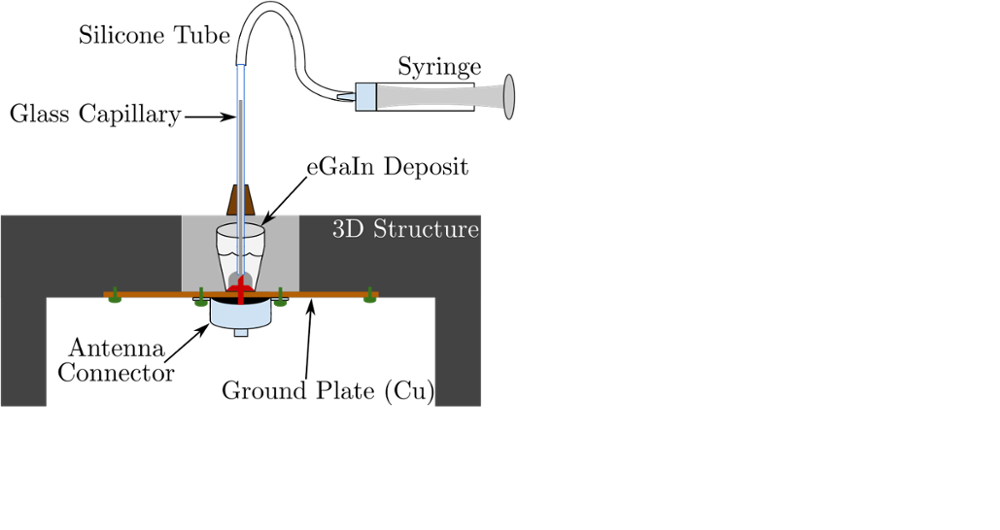
This sketch shows the proof of concept that was developed to test the capabilities of liquid antenna technologies. A plastic container filled with buffer contains a deposit in which the deposit of eGaIn lies. By Inserting a glass capillary to the liquid metal, the amount of metal flowing through the circuit is modified, affecting the resonating frequency of the equivalent monopole.
This other video: LA demo, demonstrates the process. As the syringe is actuated, the egain flows into the capillary and hence, the s11 parameter is influenced, as the resonating frequency decreases.